
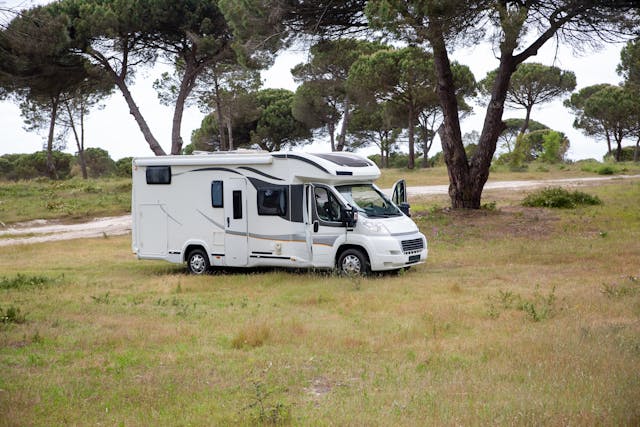
RVs are large and generally heavy, but if you ever go RVing in high winds, you might wonder if a camper or RV can tip over. The truth is, it can happen in certain scenarios. The good news is that there are steps you can take to prevent it.
Why a Camper or RV Can Tip Over in Various Situations
The size of RVs can be misleading. Today’s average trailer weighs around 5,200 pounds, with many RVs reaching up to 7,705 pounds. However, it’s not just the weight that prevents dangerous rollovers. How you drive, and occasionally where you go, are the primary factors that can cause a camper or RV to tip over.
How Do Campers and RVs Roll Over?
There are several ways a camper or RV can tip over. Let’s talk about each one.
Fishtailing
Fishtailing, jackknifing, or trailer sway—whatever the name, it’s terrifying if it happens to you.
The side-to-side movement known as fishtailing occurs when a camper trailer begins moving independently of the towing vehicle. The hitch must be located near the rear axle for trailer swaying to occur. Usually, the hitch keeps the gravity of a towing vehicle and trailer evenly matched. But when gravity is disrupted, the trailer sways.
Fishtailing happens in other situations too. For instance, if the weight distribution of a trailer is off, it can jackknife. This is why it’s important to spread cargo weight evenly across the entirety of your camper, not just in one or two corners.
Another cause of trailer fishtailing happens when too much weight is placed near the trailer hitch. This is where tongue weight comes into play. That’s the amount of downward force the hitch can handle before fishtailing kicks in. Usually, it should equal between nine and 15 percent of the total weight of the trailer.
Failing to properly correct trailer fishtailing can lead to horrible RV accidents.
Acceleration
RV speed limits exist for a reason. Some states allow more generous speeds. For instance, Alabama lets you drive 70 MPH while towing a trailer. Maine, Louisiana, Colorado, and some other states let you go even faster at 75 MPH. Nevada is by far the fastest with a limit of 80 MPH.
Just because you can go that fast while towing a trailer doesn’t mean you should.
You have to be ready to stop at a moment’s notice. Not only does your towing vehicle have to roll to a complete stop, but so does your trailer. This takes longer than you’re accustomed to when you have thousands of pounds behind your towing vehicle.
I always recommend driving within the speed limit. There’s no need to push the outer limits in a towing setup. It can be easy to start accumulating speed since you’re driving your familiar truck or SUV, but use caution. Making fast turns and other maneuvers can cause a camper or RV to tip over on the highway.
High Winds and Bad Weather
Finally, high winds and bad weather can sometimes tip RVs and trailers. One 2009 study found that it’s possible to add extra force (like 3,440 pounds extra) just by a generated crosswind of 35 miles per hour. Yikes!
Bad weather isn’t the only cause of heavy crosswinds. If a large semi-truck or other commercial vehicle rushes by you on the highway, they can also create a nasty crosswind force.
Generally, winds need to exceed 70 MPH for you to be at risk of tipping. Those winds are considered “strong gale” forces strong enough to pull roof shingles off and destroy RVs and buildings. This rarely causes trailers to tip over because most RV owners are smart enough to avoid driving in high winds.
What If Your RV Rolls Over?
If your RV is about to roll over, you will likely know. The trailer may groan, creak, or make other obvious noises indicating that a rollover is imminent. If you’re inside, you may feel it pulling towards the ground. If your trailer tips over, immediately exit your tow vehicle. The rollover could spark an electrical fire or cause a trailer explosion. Move away and get to safety.
How to Avoid a Trailer Rollover
- Use Stabilizers and Jacks: When your camper is parked, use stabilizers, jacks, and wheel chocks to keep it upright.
- Park Strategically: If possible, park your camper near a hillside or a wall to shield it from strong winds.
- Avoid Hills: Don’t park on a hill. Gravity doesn’t favor keeping heavy things propped up on inclines. If your hitch were to fail, your camper would be in serious trouble.
- Retract Slide-Outs and Awnings: Ensure all slide-outs are retracted when facing high winds. This stabilizes your vehicle. The same goes for your awning—retract it in high winds.
- Drive with the Wind: Try to drive with the wind, not against it. This not only helps with stability but also improves fuel efficiency.
- Assess the Need to Drive: Consider if driving in strong winds is necessary. If it’s not essential, avoid putting yourself in potential danger.
- Ensure Hitch Compatibility: Make sure you have a compatible hitch for your camper. Check all lugs, bolts, and parts to ensure there are no loose or missing screws. Lubricate the hitch if needed.
- Drive Carefully: Maintain a reasonable speed limit and take turns and corners slowly.
- Match Large Vehicle Pace: When driving beside a large vehicle, try to match their pace without exceeding the speed limit. This can help you avoid potentially dangerous crosswinds.